



This talktorial introduces Double Pushout (DPO) graph rewriting as a formal model for reaction rules. A rule is represented as a span that separates deleted, preserved, and created structure, then applied to molecular graphs by matching, deleting, and gluing Phan et al., 2025Ehrig et al., 2006.
Aim of this talktorial
Represent reaction rules as spans .
Implement the DPO workflow: injective matching, pushout complement, and pushout construction.
Compare the hand-built workflow with SynKit
SynReactorfor forward and inverse rule application.
Learning outcomes
After completing this talktorial, you will be able to:
write a reaction rule as
L,K, andR, and state what is deleted, preserved, and added,find injective rule matches in a host molecule,
identify symmetry-related matches and choose canonical representatives,
build the pushout complement and check the dangling condition,
construct the pushout product graph, and
chain the steps into a single pipeline that produces a rewritten product graph together with the explicit rule-to-product correspondence.
0. Setup & Data
from __future__ import annotations

import logging
import warnings

# Library progress chatter is not a lesson result; keep the output readable.
logging.disable(logging.INFO)
warnings.filterwarnings("ignore")

from dataclasses import dataclass
from typing import Dict, Hashable, Iterable, List, Tuple, Optional

import networkx as nx
from networkx.algorithms import isomorphism as iso

from rdkit import Chem
from rdkit.Chem import Draw

import rdkit
from synedu.Utils.graph import print_graph_attributes

print("RDKit:", rdkit.__version__)
print("NetworkX:", nx.__version__)
Example molecules used in this notebook
We will use a classic pericyclic transformation:
Diene: butadiene (SMILES:
C=CC=C)Dienophile: ethene (SMILES:
C=C)Combined as a disconnected reactant mixture:
C=CC=C.C=C
Chemistry caveat: this is a toy model (no stereochemistry, no substituents, no endo/exo control). The point is to demonstrate bond reorganisation under a rule-based graph rewriting view.
reactant_smiles = "C=CC=C.C=C"
react = Chem.MolFromSmiles(reactant_smiles)
Chem.SanitizeMol(react)

display(react)
print("Reactant SMILES (canonical-ish):", Chem.MolToSmiles(react))
1. Reaction rules
A reaction rule is a DPO span Ehrig et al., 2006Ehrig et al., 1997
where is the reacting pattern, the replacement, and the preserved context.
Chemically:
Bond-order changes appear as deletion in and creation in with endpoints fixed in .
We use a classic pericyclic transformation as the running example:
Diene: butadiene (SMILES:
C=CC=C)Dienophile: ethene (SMILES:
C=C)Product: cyclohexene (SMILES:
C1C=CCCC1)
Definition (DPO Reaction Rule / Span).
A DPO reaction rule is a pair of injective graph homomorphisms
where , , are labeled graphs (with node attributes and edge attributes ), and are inclusions.
— the gluing graph or interface: atoms and bonds preserved by the reaction
— atoms and bonds consumed (deleted) in the left-hand side
— atoms and bonds produced (created) in the right-hand side
Definition (Pattern Match).
A match of rule in a host graph is an injective graph homomorphism that is label-preserving. A match is valid if it satisfies the dangling condition: no edge is incident to a deleted node , , without also being in .
Definition (DPO Rewriting Step).
Given a valid match , the DPO rewriting step produces the result graph by the double pushout construction:
where is the pushout complement (host minus deleted items) and is obtained by gluing to along .
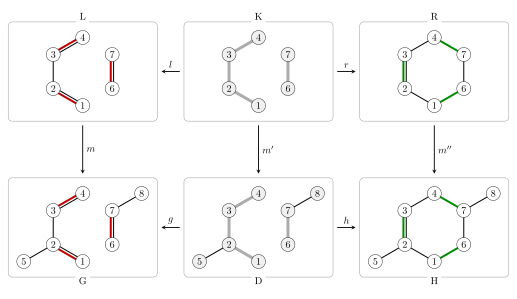
Figure 1. DPO span for the Diels–Alder reaction: rule span L ←l K →r R (top) and its application G ←g D →h H (bottom). Red bonds are broken; green bonds are formed; grey nodes/bonds are preserved context.
from synedu.Utils.reaction import rsmi_to_graph
from synedu.Utils.Vis.dpo import visualize_dpo_rule

# Define atom-mapped left- and right-hand patterns.
aam = '[C:5]=[C:6].[C:2]([C:3]=[C:4])=[C:1]>>[C:2]1=[C:3][C:4][C:5][C:6][C:1]1'
L, R = rsmi_to_graph(aam)

axes, dec, pos, its = visualize_dpo_rule(
    L,
    R,
    use_its=False,
    title=None,
    show_legends=False,
    show_edge_labels=False,
    show_node_labels=False,
    node_size=500,
)
axes, dec, pos, its = visualize_dpo_rule(
    L,
    R,
    use_its=True,
    title=None,
    show_legends=False,
    show_edge_labels=False,
    show_node_labels=False,
)
from __future__ import annotations
from typing import Tuple
import networkx as nx
def _get_k(
L: nx.Graph,
R: nx.Graph,
*,
order_key: str = "order",
keep_k_node_attrs: Tuple[str, ...] = ("element", "aromatic", "atom_map"),
) -> nx.Graph:
"""
Build interface graph K from L and R as:
- nodes: intersection of node IDs
- edges: bonds present with the same label on both sides
A changed bond is not part of the interface: it is deleted from L and
created from R. This keeps both inclusions K -> L and K -> R
label-preserving.
"""
K = nx.Graph()
# nodes in both
common_nodes = set(L.nodes()) & set(R.nodes())
for n in common_nodes:
# Prefer L's attrs, fallback to R; keep only stable attrs
d = dict(L.nodes[n]) if n in L.nodes else {}
if not d and n in R.nodes:
d = dict(R.nodes[n])
K.add_node(n, **{k: d[k] for k in keep_k_node_attrs if k in d})
l_edges = {frozenset((u, v)): (u, v, d) for u, v, d in L.edges(data=True)}
r_edges = {frozenset((u, v)): (u, v, d) for u, v, d in R.edges(data=True)}
for edge_key in set(l_edges) & set(r_edges):
u, v, l_data = l_edges[edge_key]
r_data = r_edges[edge_key][2]
if float(l_data.get(order_key, 0.0)) != float(
r_data.get(order_key, 0.0)
):
continue
if bool(l_data.get("aromatic", False)) != bool(
r_data.get("aromatic", False)
):
continue
K.add_edge(u, v, **dict(l_data))
return K
# usage:
K = _get_k(L, R)
print_graph_attributes(K)2. Double Pushout Graph Rewriting
Two categorical pushouts compactly encode Ehrig et al., 2006Ehrig et al., 1997 the familiar chemical workflow delete → add (remove broken bonds / atoms, then glue in the new fragment). The usual DPO diagram is:
— left-hand side (pattern to match: atoms/bonds that may be deleted or preserved).
— right-hand side (pattern to be inserted).
— interface / context (the part preserved during the rewrite: ).
— the match (where the rule is found inside the host graph ).
— the pushout complement (result of deleting from ).
— the product graph after the rewrite.
Chemical intuition
find the pattern in molecule (this chooses where the chemistry happens);
remove the atoms/bonds that should disappear (everything in ) — this is the deletion step;
attach the new fragment to the remaining context — this is the addition step;
the result is the new molecule after the transformation.
Formal constraints
Injective match The mapping must be injective (no two distinct nodes in map to the same node of ). This prevents unwanted atom merging.
Dangling condition (no half-bonds) If a node of is removed, we must not leave an edge with only one endpoint. Formally:
Let be the deleted nodes and be the deleted edges. Formally:
Equivalently: no host edge outside may be incident to a deleted node, otherwise you would create a dangling (half) bond.
Chemical sanity after rewrite After forming check chemical invariants you care about (valence bounds, formal charge consistency, stereochemistry handling, etc.). These are domain-specific checks not enforced by the abstract DPO construction.
The following Diels–Alder example demonstrates the construction.
from synedu.Utils.conversion import smiles_to_graph
from synedu.Utils.vis import draw_molecular_graph

# for simple modeling, we use reaction that does not require hydrogen
input = 'CC=CC=C.C=CC=O'

G = smiles_to_graph(input)

import matplotlib.pyplot as plt

fig, ax = plt.subplots(1, 2, figsize=(16, 8))

draw_molecular_graph(
    L,
    show_indices=True,
    ax=ax[0],
)

draw_molecular_graph(
    G,
    show_indices=True,
    ax=ax[1],
)

plt.tight_layout()
2.1. Pattern matching (where a rule applies)
A reaction rule is given as a span
where is the reactant pattern, the product pattern, and the interface of conserved atoms.
Given a host (reactant) molecular graph , the rule applies at any injective match
that is, a labeled subgraph monomorphism embedding the reaction pattern into the host graph and thereby identifying the reaction center.
Below, node_match/edge_match encode label compatibility and are passed to
NetworkX’s GraphMatcher, which implements the VF2 algorithm for (sub)graph
isomorphism and monomorphism enumeration Cordella et al., 2004.
_automorphisms recovers as the set of label-preserving
isomorphisms .
from typing import Any, Callable, Dict, List

import networkx as nx
from networkx.algorithms import isomorphism as iso


def node_match(L_node: dict, G_node: dict) -> bool:
    eL = L_node.get("element")
    eG = G_node.get("element")
    return (eL is None) or (eG is None) or (eL == eG)


def edge_match(L_edge: dict, G_edge: dict) -> bool:
    oL = L_edge.get("order")
    oG = G_edge.get("order")
    return (oL is None) or (oG is None) or (float(oL) == float(oG))


def _automorphisms(
    H: nx.Graph,
    *,
    node_match: Callable[[dict, dict], bool],
    edge_match: Callable[[dict, dict], bool],
) -> List[Dict[Any, Any]]:
    GM = iso.GraphMatcher(H, H, node_match=node_match, edge_match=edge_match)
    return list(GM.isomorphisms_iter())  # H -> H
from synedu.Utils.graph import enumerate_automorphismsQ1 — Pattern match
Implement find_pattern_match(G, L) using node_match, edge_match, _automorphisms; enumerate all injective embeddings and yield one canonical representative per Aut(L) orbit, then run on the given L/G.
Solution:
def find_pattern_match(G: nx.Graph, L: nx.Graph) -> Iterable[Dict[Any, Any]]:
    """Yield one representative per Aut(L)-orbit of subgraph monomorphisms L -> G."""
    # automorphisms of L (L -> L)
    auts = list(iso.GraphMatcher(L, L, node_match=node_match, edge_match=edge_match).isomorphisms_iter())
    L_nodes = tuple(sorted(L.nodes()))
    seen: Set[Tuple[Any, ...]] = set()

    # find embeddings (G -> L -> invert to L -> G)
    GM = iso.GraphMatcher(G, L, node_match=lambda Gd, Ld: node_match(Ld, Gd),
                                  edge_match=lambda Gd, Ld: edge_match(Ld, Gd))
    for m_G_to_L in GM.subgraph_isomorphisms_iter():
        m = {l: g for g, l in m_G_to_L.items()}  # L -> G
        key = min((tuple(m[a[n]] for n in L_nodes) for a in auts), default=tuple(m[n] for n in L_nodes))
        if key in seen:
            continue
        seen.add(key)
        yield m

maps  = find_pattern_match(G, L)
for i in maps:
    print(i)
Output
{5: 6, 6: 7, 2: 3, 3: 4, 4: 5, 1: 2}rawlists all injective embeddings (here: 4 raw maps).Do not quotient by the full
Aut(L)whenLis disconnected — that mixes symmetries across fragments and over-collapses distinct placements.Fix (generic): choose one anchor component (e.g. largest or explicit
anchor_nodes) and do not quotient that component; quotient only the other components by their ownAut.Use a component-aware matcher (e.g.
find_pattern_match_components(anchor="largest")).With this policy your example yields 2 canonical maps (diene orientations kept distinct, ethene deduped) instead of 1.
import itertools
import networkx as nx
from networkx.algorithms import isomorphism as iso


def find_pattern_match_components(
    host: nx.Graph,
    pattern: nx.Graph,
    *,
    anchor: str = "largest",
):
    """
    Split the pattern into connected components; keep raw matches for the
    anchor component (so its placements stay distinct), but quotient other
    components by Aut(component).

    Returns
    -------
    list[dict]
        Each dict is a node mapping {pattern_node -> host_node}.
    """
    # --- split pattern into connected components ---
    comps = [pattern.subgraph(ns).copy() for ns in nx.connected_components(pattern)]

    if anchor == "largest":
        anchor_idx = max(
            range(len(comps)),
            key=lambda i: (comps[i].number_of_nodes(), comps[i].number_of_edges()),
        )
    else:
        anchor_idx = 0

    comp_reps = []

    # --- compute representatives per component ---
    for i, C in enumerate(comps):
        matcher = iso.GraphMatcher(
            host,
            C,
            node_match=lambda Hd, Cd: node_match(Cd, Hd),
            edge_match=lambda Hd, Cd: edge_match(Cd, Hd),
        )

        # raw matches: pattern_node -> host_node
        raw = [
            {c: h for h, c in m.items()} for m in matcher.subgraph_isomorphisms_iter()
        ]

        if i == anchor_idx:
            reps = raw
        else:
            auts = _automorphisms(C, node_match=node_match, edge_match=edge_match)
            C_nodes = tuple(sorted(C.nodes()))

            seen_keys = set()
            reps = []

            for m in raw:
                # canonical key under automorphism action
                key = min(
                    (tuple(m[a[v]] for v in C_nodes) for a in auts),
                    default=tuple(m[v] for v in C_nodes),
                )

                if key in seen_keys:
                    continue

                seen_keys.add(key)
                reps.append(m)

        comp_reps.append(reps)

    # --- combine component matches ---
    results = []

    for choice in itertools.product(*comp_reps):
        used = set()
        out = {}
        ok = True

        for m in choice:
            vals = set(m.values())
            if used & vals:
                ok = False
                break
            used |= vals
            out.update(m)

        if ok:
            results.append(out)

    return results
matches = find_pattern_match_components(G, L)
matchesPattern match gallery — all valid matches of in 
Pattern matching is the subgraph-isomorphism step that decides where a rule may apply NetworkX Developers, 2026.
We enumerate all injective matches and display each one, highlighting the matched subgraph in . Orbit-deduplication then collapses symmetry-equivalent matches.
Source
import matplotlib.pyplot as plt
import matplotlib.patches as mpatches
from synedu.Utils.vis import draw_molecular_graph, _layout_from_graph_mol

# ── colour palette: one colour per L-node ────────────────────────────────────
_PAL = [
    "#1F77B4",
    "#D62728",
    "#2CA02C",
    "#FF7F0E",
    "#9467BD",
    "#8C564B",
    "#E377C2",
    "#17BECF",
]

_all_matches = find_pattern_match_components(G, L)
_n_raw = len(_all_matches)
_show = _all_matches[: min(4, _n_raw)]

_L_nodes = sorted(L.nodes())
_l_color = {n: _PAL[i % len(_PAL)] for i, n in enumerate(_L_nodes)}

# ── layout: row 0 = L replicated, row 1 = G with coloured match ──────────────
_ncols = len(_show)
fig = plt.figure(figsize=(_ncols * 4.2, 8.5), facecolor="white")
fig.suptitle(
    f"Pattern $L$ → Host $G$: {_n_raw} injective match(es)."
    "Colours link each L-node to its image in G.",
    fontsize=12,
    fontweight="bold",
)

# pre-compute G layout once (same as draw_molecular_graph uses internally)
_G_pos = _layout_from_graph_mol(G, sorted(G.nodes()))

for k, match in enumerate(_show):
    # ── left: pattern L ──────────────────────────────────────────────────────
    ax_L = fig.add_subplot(2, _ncols, k + 1)
    draw_molecular_graph(
        L,
        ax=ax_L,
        custom_node_colors=_l_color,
        label_mode="all",
        show_indices=True,
        title="Pattern $L$" if k == 0 else "",
    )
    if k == 0:
        ax_L.set_ylabel("Pattern", fontsize=10, labelpad=4)

    # ── right: host G, matched nodes painted in their L-node colour ──────────
    ax_G = fig.add_subplot(2, _ncols, _ncols + k + 1)

    _inv = {g_node: _l_color[l_node] for l_node, g_node in match.items()}
    _hl_nodes = set(match.values())
    _hl_edges = {(u, v) for u, v in G.edges() if u in _hl_nodes and v in _hl_nodes}

    draw_molecular_graph(
        G,
        ax=ax_G,
        custom_node_colors=_inv,
        highlight_nodes=_hl_nodes,
        highlight_edges=_hl_edges,
        label_mode="all",
        show_indices=True,
        title=f"Match {k + 1}/{_n_raw}",
    )
    if k == 0:
        ax_G.set_ylabel("Host $G$", fontsize=10, labelpad=4)

    # annotate each matched G-node with its L counterpart using the real layout
    for l_node, g_node in sorted(match.items()):
        x, y = _G_pos[g_node]
        ax_G.annotate(
            f"L{l_node}",
            xy=(x, y),
            xytext=(x, y + 0.22),
            fontsize=7,
            ha="center",
            va="bottom",
            color=_l_color[l_node],
            fontweight="bold",
            zorder=15,
            annotation_clip=False,
        )

plt.tight_layout(rect=[0, 0, 1, 0.92])
plt.show()
print(f"Total injective matches: {_n_raw}")
2.2. Pushout Complement
Given graphs , , a host graph , and an injective match
the pushout complement is
if it exists.
Deletion
with all attributes and node IDs inherited from (G).
Dangling condition
Interface map
Example — Dangling condition
Consider a molecular graph (ethanol):
Edges:
Invalid pushout complement (dangling)
Let
with injective match
Then
But in :
Both host edges and lie outside while touching the deleted node. Removing would therefore leave dangling half-edges at and .
❌ Dangling condition violated → no pushout complement.
Valid pushout complement (corrected)
Consider the ethanol host graph
Let the rule delete the entire molecule:
with injective match
Then
Every edge of (G) is incident to deleted nodes and is contained in (m(E(L))), so no half-edges are created.
Remaining graph:
✅ Dangling condition satisfied.
Q2 — Dangling condition
Implement violates_dangling(G, L, K, m) to verify whether a given match m : L -> G
violates the DPO dangling condition (i.e. some edge in G is incident to a deleted node
but is not deleted as part of L \ K).
Solution
import networkx as nx
from typing import Dict, Hashable, Set, FrozenSet

def violates_dangling(
    G: nx.Graph,
    L: nx.Graph,
    K: nx.Graph,
    m: Dict[Hashable, Hashable],  # L.node -> G.node
) -> bool:

    # basic sanity checks
    if not set(K.nodes).issubset(set(L.nodes)):
        raise ValueError("K must be a subgraph of L (K.nodes ⊆ L.nodes).")
    if set(m.keys()) != set(L.nodes) and not set(L.nodes).issubset(set(m.keys())):
        # allow m to be defined on a superset but require mapping for all L.nodes
        raise ValueError("Mapping m must provide an image for every node in L.")
    if len(set(m[v] for v in L.nodes)) != len(list(L.nodes)):
        raise ValueError("Mapping m must be injective on L.nodes.")

    # nodes to be deleted: image of L \ K
    V_del: Set[Hashable] = {m[v] for v in L.nodes if v not in K.nodes}

    # edges to be deleted: image of edges in L that are not fully contained in K
    E_del: Set[FrozenSet[Hashable]] = set()
    for u, v in L.edges:
        # if at least one endpoint lies in L\K, that L-edge will be removed
        if (u not in K.nodes) or (v not in K.nodes):
            E_del.add(frozenset({m[u], m[v]}))

    # check every edge in G: if it touches a deleted node it must be in E_del
    for u, v in G.edges:
        e = frozenset({u, v})
        if (u in V_del) or (v in V_del):
            if e not in E_del:
                return True
    return False


# 1) Invalid: delete only middle carbon -> dangling at O3
L1 = nx.Graph()
L1.add_node("c2")
K1 = nx.Graph()  # empty
m1 = {"c2": 2}
print("case1 (delete c2 only) ->", violates_dangling(G, L1, K1, m1))  # True

# 2) Invalid: delete c2 + o3 but L does NOT include edge {c1,c2} -> dangling at C1
L2 = nx.Graph()
L2.add_nodes_from(["c2", "o3"])
L2.add_edge("c2", "o3")
K2 = nx.Graph()  # empty
m2 = {"c2": 2, "o3": 3}
print("case2 (delete c2+o3 but L misses c1-c2) ->", violates_dangling(G, L2, K2, m2))  # True

# 3) Valid substitution: delete O3 (leaving group), preserve C1-C2 backbone
L3 = nx.Graph()
L3.add_nodes_from(["c1", "c2", "o3"])
L3.add_edges_from([("c1", "c2"), ("c2", "o3")])
K3 = nx.Graph()
K3.add_nodes_from(["c1", "c2"])
K3.add_edge("c1", "c2")
m3 = {"c1": 1, "c2": 2, "o3": 3}
print("case3 (substitution C-C-O -> C-C-? ) ->", violates_dangling(G, L3, K3, m3))  # False
from __future__ import annotations
from typing import Any, Dict, Iterable, List, Tuple
import networkx as nx
def pushout_complement(
L: nx.Graph,
K: nx.Graph,
G: nx.Graph,
m: Dict[Any, Any],
*,
order_key: str = "order",
check_injective: bool = True,
check_structure: bool = True,
check_dangling_nodes: bool = True,
) -> Tuple[nx.Graph, Dict[Any, Any]]:
# --- sanity: match covers L nodes ---
missing = [u for u in L.nodes() if u not in m]
if missing:
raise KeyError(f"Match m missing images for L nodes: {missing}")
if check_injective:
imgs = list(m.values())
if len(set(imgs)) != len(imgs):
raise ValueError("Match m must be injective.")
# --- node deletions ---
del_L_nodes = set(L.nodes()) - set(K.nodes())
del_G_nodes = {m[u] for u in del_L_nodes}
# --- edge sets (by unordered endpoints) ---
K_edges = {frozenset((u, v)) for u, v in K.edges()}
L_edges = {frozenset((u, v)) for u, v in L.edges()}
# Edges deleted by the rule, mapped into G.
del_L_edges = [e for e in L_edges if e not in K_edges]
del_G_edge_keys = {
frozenset((m[u], m[v]))
for edge in del_L_edges
for u, v in [tuple(edge)]
}
# Dangling condition: every host edge incident to a deleted node must be
# the image of an edge explicitly deleted by L <- K.
if check_dangling_nodes:
for gx in del_G_nodes:
for gy in G.neighbors(gx):
if frozenset((gx, gy)) not in del_G_edge_keys:
raise ValueError(
"Dangling condition violated: edge "
f"({gx}, {gy}) is incident to a deleted node but is "
"not deleted by the rule."
)
# --- start D as a copy of G ---
D = G.copy()
# 1) delete edges in m(E(L\\K)) whose endpoints survive
del_G_edges: List[Tuple[Any, Any]] = []
for e in del_L_edges:
u, v = tuple(e)
gu, gv = m[u], m[v]
if gu in del_G_nodes or gv in del_G_nodes:
continue # will be removed with node deletion
if check_structure and not G.has_edge(gu, gv):
raise ValueError(
f"Match not structure-preserving: G missing edge ({gu},{gv}) for L edge ({u},{v})."
)
del_G_edges.append((gu, gv))
D.remove_edges_from([(u, v) for (u, v) in del_G_edges if D.has_edge(u, v)])
# 2) delete nodes (removes incident edges)
D.remove_nodes_from([n for n in del_G_nodes if n in D])
# 3) Verify that the preserved interface is still present. Interface edge
# labels already agree with L and R, so no relabeling occurs here.
for u, v, kdata in K.edges(data=True):
gu, gv = m[u], m[v]
if gu in del_G_nodes or gv in del_G_nodes:
# should not happen since K nodes are preserved
raise ValueError(f"K edge ({u},{v}) maps to deleted node in G.")
if check_structure and not D.has_edge(gu, gv):
raise ValueError(
f"Interface edge ({gu},{gv}) missing in D after deletions."
)
if order_key not in kdata:
raise KeyError(f"K edge ({u},{v}) missing '{order_key}'")
if float(D.edges[gu, gv].get(order_key, 0.0)) != float(
kdata[order_key]
):
raise ValueError(
f"Interface edge ({gu},{gv}) is not label-preserving."
)
m_K = {k: m[k] for k in K.nodes()}
return D, m_KThe two matches produce two corresponding pushout complements (D).
D1, mk1 = pushout_complement(L, K, G, matches[0])
D2, mk2 = pushout_complement(L, K, G, matches[1])

fig, ax = plt.subplots(1, 2, figsize=(16, 8))

draw_molecular_graph(
    D1,
    show_indices=True,
    ax=ax[0],
)

draw_molecular_graph(
    D2,
    show_indices=True,
    ax=ax[1],
)
Pushout complement: (deletion step)
is obtained by removing the atoms/bonds in from . The highlighted region in shows which nodes/edges are matched and will be deleted.
Source
import matplotlib.pyplot as plt
from synedu.Utils.vis import draw_molecular_graph

# D1 already computed: D1, mk1 = pushout_complement(L, K, G, matches[0])
_matched_g_nodes = set(matches[0].values())
_matched_g_edges = {
    (u, v) for u, v in G.edges() if u in _matched_g_nodes and v in _matched_g_nodes
}

fig, axes = plt.subplots(1, 2, figsize=(11, 4.5), facecolor='white')

draw_molecular_graph(
    G,
    ax=axes[0],
    highlight_nodes=_matched_g_nodes,
    highlight_edges=_matched_g_edges,
    highlight_color='#D62728',
    show_indices=True,
    title='Host $G$\n(red = matched region $m(L)$, to be modified)',
)

draw_molecular_graph(
    D1,
    ax=axes[1],
    show_indices=True,
    title='Pushout complement $D = G \\setminus m(L \\setminus K)$',
)

fig.suptitle(
    'DPO Step 1: Pushout Complement $G \\to D$', fontsize=12, fontweight='bold'
)
plt.tight_layout()
plt.show()
print(f'G: {G.number_of_nodes()} nodes, {G.number_of_edges()} edges')
print(f'D: {D1.number_of_nodes()} nodes, {D1.number_of_edges()} edges')
2.3 Pushout
Given (D), (m’) (equivalently (m_K)), the interface (K), and the right-hand pattern (R), the pushout constructs (H):
where maps for and sends to fresh copies in .
def pushout(
    R: nx.Graph,
    K: nx.Graph,
    D: nx.Graph,
    m_K: Dict[Any, Any],
    *,
    order_key: str = "order",
    strict_id_freshness: bool = True,
) -> Tuple[nx.Graph, Dict[Any, Any]]:

    K_nodes = set(K.nodes())
    R_nodes = set(R.nodes())
    D_nodes = set(D.nodes())

    if not K_nodes.issubset(R_nodes):
        raise ValueError("K.nodes() must be subset of R.nodes()")
    if not set(m_K.keys()).issuperset(K_nodes):
        raise ValueError("m_K must be defined on all K nodes")
    if not set(m_K.values()).issubset(D_nodes):
        raise ValueError("m_K images must lie in D")

    # start with H = D
    H = D.copy()

    # build node map h: R -> H
    h: Dict[Any, Any] = {}

    # interface nodes: use m_K
    for k in K_nodes:
        h[k] = m_K[k]

    # nodes in R\K: create fresh nodes in H
    # (If IDs already exist in H and strict_id_freshness=False, reuse them.)
    for v in R_nodes - K_nodes:
        if v in H:
            if strict_id_freshness:
                raise ValueError(f"Node id collision outside K: {v}")
            # reuse existing id
            h[v] = v
        else:
            H.add_node(v, **dict(R.nodes[v]))
            h[v] = v

    # add edges from R (mapped into H) and relabel to R's order
    for u, v, edata in R.edges(data=True):
        hu, hv = h[u], h[v]

        if not H.has_node(hu) or not H.has_node(hv):
            raise ValueError(
                f"Internal error: mapped endpoints missing in H for R edge ({u},{v})"
            )

        if not H.has_edge(hu, hv):
            H.add_edge(hu, hv, **dict(edata))

        # relabel bond order to R's order (your semantics)
        if order_key not in edata:
            raise KeyError(f"R edge ({u},{v}) missing '{order_key}'")
        H.edges[hu, hv][order_key] = float(edata[order_key])

    return H, h
H1, h1 = pushout(R, K, D1, mk1)
H2, h2 = pushout(R, K, D2, mk2)Pushout step by step
DPO rewriting proceeds in two stages:
Pushout complement — remove the matched atoms/bonds that belong to but not (orange region).
Pushout — glue onto along the interface .
Each panel below corresponds to one stage for match 1 of the Diels-Alder rule.
Source
from synedu.Utils.vis import draw_molecular_graph
import matplotlib.pyplot as plt

# highlight the matched region of L in G
_matched_g_nodes = set(matches[0].values())
_matched_g_edges = {
    (u, v) for u, v in G.edges() if u in _matched_g_nodes and v in _matched_g_nodes
}

fig, axes = plt.subplots(1, 3, figsize=(18, 5))
fig.suptitle(
    "DPO pushout — step by step  (Diels-Alder, match 1)", fontsize=11, fontweight="bold"
)

draw_molecular_graph(
    G,
    ax=axes[0],
    show_indices=True,
    highlight_nodes=_matched_g_nodes,
    highlight_edges=_matched_g_edges,
    highlight_color="#FF7F0E",
)
axes[0].set_title(
    "Host graph G\n(orange = matched region m(L))", fontsize=9, weight="bold"
)

draw_molecular_graph(D1, ax=axes[1], show_indices=True)
axes[1].set_title(
    "Pushout complement D₁\n(G minus deleted atoms/bonds)", fontsize=9, weight="bold"
)

draw_molecular_graph(H1, ax=axes[2], show_indices=True)
axes[2].set_title("Product H₁\n(D₁ ∪K R)", fontsize=9, weight="bold")

plt.tight_layout()
plt.show()
Q3 — Implicit hydrogen
Convert explicit hydrogen nodes into an integer hcount attribute on their bonded heavy atom.
Robust, configurable, and returns a new graph (or mutates in-place).
Solution
import networkx as nx
def h_to_implicit(G: nx.Graph) -> nx.Graph:
    """Convert explicit hydrogen atoms to implicit counts on heavy atoms.

    For each hydrogen atom ('element' == 'H'), its neighbor (assumed to be a heavy atom)
    will have its 'hcount' attribute incremented. The hydrogen nodes are then removed.

    Parameters
    ----------
    G : nx.Graph
        Input graph with explicit hydrogen atoms as nodes (element='H').
        Heavy atoms must have 'element' and optionally 'hcount' attributes.

    Returns
    -------
    nx.Graph
        A copy of the original graph with hydrogen atoms removed and their counts
        added to the corresponding heavy atoms' 'hcount' attribute.
    """
    H2 = G.copy()
    h_nodes = [n for n, d in H2.nodes(data=True) if d.get("element") == "H"]

    for h in h_nodes:
        neighbors = list(H2.neighbors(h))
        for heavy in neighbors:
            if H2.nodes[heavy].get("element") != "H":
                H2.nodes[heavy]["hcount"] = H2.nodes[heavy].get("hcount", 0) + 1
        H2.remove_node(h)

    return H2
The complete DPO application pipeline is:
from synedu.Utils.conversion import graph_to_smi, smiles_to_graph
from synedu.Utils.reaction import rsmi_to_graph
from synedu.Utils.graph import h_to_implicit


def dpo_rule_apply(smiles, rule):
    G = smiles_to_graph(smiles)
    L, R = rsmi_to_graph(rule)

    # 1. find match
    matches = find_pattern_match_components(host=G, pattern=L)

    # 2. Build pushout complement
    Ds, mks = zip(*(pushout_complement(L, K, G, m) for m in matches))

    # 3. Pushout
    Hs, _ = zip(*(pushout(R, K, D, mk) for D, mk in zip(Ds, mks)))
    Hs = [h_to_implicit(i) for i in list(Hs)]

    # 4 sanity check
    out_smi = [smi for H in Hs if (smi := graph_to_smi(H)) is not None]
    out_rsmi = [f'{smiles}>>{i}' for i in out_smi]
    return out_rsmi
# Define atom-mapped left- and right-hand patterns.
input = 'CC=CC=C.C=CC=O'
rule = '[C:5]=[C:6].[C:2]([C:3]=[C:4])=[C:1]>>[C:2]1=[C:3][C:4][C:5][C:6][C:1]1'
dpo_rule_apply(input, rule)How do we obtain atom maps for the generated reactions?
In DPO rewriting we explicitly construct the transformation
rather than inferring correspondence post hoc.
Key observation
Nodes of the host graph (G) that are preserved through the pushout complement and pushout remain the same graph nodes in (H).
Therefore, node indices are preserved along the rewrite.
Consequence
We can directly use the node index as the atom-map number:
import networkx as nx
from typing import Hashable


def set_atom_map_from_node_index(
    G: nx.Graph,
    *,
    atom_map_attr: str = "atom_map",
    inplace: bool = False,
) -> nx.Graph:
    H = G if inplace else G.copy()

    for v in H.nodes:
        H.nodes[v][atom_map_attr] = v

    return H
def dpo_rule_apply(smiles, rule, use_aam=True):
"""
Apply a DPO rewrite rule to an input SMILES.
Pipeline:
1) SMILES -> host graph G
2) Rule -> L, R graphs
3) Find injective matches m : L -> G
4) Pushout complement: (D, m_K)
5) Pushout: D + R -> H
6) Convert explicit H to implicit hydrogens
7) Graph -> product SMILES
"""
# 0. Parse input
G = smiles_to_graph(smiles)
L, R = rsmi_to_graph(rule)
# 1. Find matches m : L -> G
matches = list(find_pattern_match_components(host=G, pattern=L))
if not matches:
return []
# 2. Pushout complements
Ds = []
mks = []
for m in matches:
try:
D, mk = pushout_complement(L, K, G, m)
except ValueError:
# dangling condition or invalid match
continue
Ds.append(D)
mks.append(mk)
if not Ds:
return []
# 3. Pushouts
Hs = []
for D, mk in zip(Ds, mks):
try:
H, _ = pushout(R, K, D, mk)
except ValueError:
continue
Hs.append(h_to_implicit(H))
if not Hs:
return []
if use_aam:
G = set_atom_map_from_node_index(G)
smiles = graph_to_smi(G)
Hs = [set_atom_map_from_node_index(i) for i in Hs]
# 4. Convert to SMILES (single evaluation, deduplicated)
out_smi = {smi for H in Hs if (smi := graph_to_smi(H)) is not None}
return [f"{smiles}>>{smi}" for smi in out_smi]input = 'CC=CC=C.C=CC=O'
rule = '[C:5]=[C:6].[C:2]([C:3]=[C:4])=[C:1]>>[C:2]1=[C:3][C:4][C:5][C:6][C:1]1'
rsmi1, rsmi2 = dpo_rule_apply(input, rule, True)Source
from synedu.Utils.rxn_vis import visualize_reaction
from IPython.display import SVG

svg1 = visualize_reaction(
    rsmi1,
    svg=True,
    highlight_changes=True,
    legend="candidate 1",
)
svg2 = visualize_reaction(
    rsmi2,
    svg=True,
    highlight_changes=True,
    legend="candidate 2",
)
display(SVG(svg1))
display(SVG(svg2))
Q4 — Inverse rule application
Given an input SMILES CC1C=CCCC1C=O, can we apply the inverse of the above rule?
Solution
Yes.
In DPO rewriting, a rule
def dpo_rule_apply(smiles, rule, use_aam=True, inverse = False):

    # 0. Parse input
    G = smiles_to_graph(smiles)

    if inverse:
        R, L = rsmi_to_graph(rule)
    else:
        L, R = rsmi_to_graph(rule)

    # 1. Find matches m : L -> G
    matches = list(find_pattern_match_components(host=G, pattern=L))
    if not matches:
        return []

    # 2. Pushout complements
    Ds = []
    mks = []
    for m in matches:
        try:
            D, mk = pushout_complement(L, K, G, m)
        except ValueError:
            # dangling condition or invalid match
            continue
        Ds.append(D)
        mks.append(mk)

    if not Ds:
        return []

    # 3. Pushouts
    Hs = []
    for D, mk in zip(Ds, mks):
        try:
            H, _ = pushout(R, K, D, mk)
        except ValueError:
            continue
        Hs.append(h_to_implicit(H))

    if not Hs:
        return []

    if use_aam:
        G = set_atom_map_from_node_index(G)
        smiles = graph_to_smi(G)
        Hs = [set_atom_map_from_node_index(i) for i in Hs]
    # 4. Convert to SMILES (single evaluation, deduplicated)
    out_smi = {
        smi
        for H in Hs
        if (smi := graph_to_smi(H)) is not None
    }

    return [f"{smiles}>>{smi}" for smi in out_smi]
3. SynKit
Instead of implementing the full DPO pipeline manually, we can directly use
SynReactor from SynKit, which natively supports DPO rewriting with
implicit hydrogens.
from synkit.Synthesis.Reactor.syn_reactor import SynReactor

input = 'CC1C=CCCC1C=O'
rule = '[C:5]=[C:6].[C:2]([C:3]=[C:4])=[C:1]>>[C:2]1=[C:3][C:4][C:5][C:6][C:1]1'

reactor = SynReactor(
    substrate=input,
    template=rule,
    invert=True,
    implicit_temp=True,
    explicit_h=False,
    automorphism=True,
)
reactor.smarts
Forward vs inverse rule application
The same DPO span works in both directions:
Forward: Diels–Alder cyclization (diene + dienophile → cyclohexene)
Inverse: retrosynthetic disconnection (cyclohexene → diene + dienophile)
Swapping and is all it takes.
Source
import matplotlib.pyplot as plt
from synedu.Utils.vis import draw_molecular_graph
from synedu.Utils.conversion import smiles_to_graph, graph_to_smi

# Forward: diene + dienophile → cyclohexene
_fw_rsmi = 'C=CC=C.C=C>>C1CC=CC=C1'  # Diels-Alder
# Inverse: cyclohexene → open chain
_bw_rsmi = 'C1CC=CC=C1>>C=CC=C.C=C'

_pairs = [('Forward (synthesis)', _fw_rsmi), ('Inverse (retrosynthesis)', _bw_rsmi)]

fig, axes = plt.subplots(2, 2, figsize=(12, 7), facecolor='white')

for row, (direction, rsmi) in enumerate(_pairs):
    parts = rsmi.split('>>')
    _r_smi, _p_smi = parts[0], parts[1]
    try:
        from synedu.Utils.reaction import rsmi_to_graph as _r2g

        _rg, _pg = _r2g(rsmi)
        draw_molecular_graph(
            _rg, ax=axes[row, 0], title=f'{direction}\nReactant(s): {_r_smi}'
        )
        draw_molecular_graph(_pg, ax=axes[row, 1], title=f'Product(s): {_p_smi}')
    except Exception as e:
        for col in range(2):
            axes[row, col].text(
                0.5,
                0.5,
                str(e)[:60],
                transform=axes[row, col].transAxes,
                ha='center',
                va='center',
                fontsize=8,
            )
            axes[row, col].set_axis_off()

fig.suptitle(
    'DPO Rule: Forward Synthesis vs Retrosynthetic Disconnection',
    fontsize=12,
    fontweight='bold',
)
plt.tight_layout()
plt.show()
4. Discussion
Key Takeaways
DPO graph rewriting provides a precise, reversible, and composable framework for reaction rules.
The span representation
A reaction rule as a span cleanly separates:
| Component | Meaning | Chemical interpretation |
|---|---|---|
| deleted items | bonds broken, atoms leaving | |
| preserved context | atoms present in both reactant and product | |
| created items | bonds formed, atoms added |
For bond changes, this corresponds to the non-zero off-diagonal entries of the ΔBE matrix introduced in S04.
The dangling condition
The dangling condition is a structural correctness requirement: ignoring it would leave edges whose deleted endpoint no longer exists. Implicit hydrogens need separate domain-aware bookkeeping because they are attributes of the heavy-atom graph rather than explicit DPO vertices; any hydrogen-count update must also pass the chemical validation step.
Reversibility
At the level of an unconditional DPO span, swapping and defines the
inverse rule, and a valid forward derivation can be read backward. This does
not make retrosynthesis unique: the inverse rule may have many matches, and
chemical application conditions or post-processing constraints must also be
reversed appropriately. S08 reuses SynReactor with and
exchanged to enumerate those backward candidates.
Orbit-aware deduplication (connection to S02)
Two matches that differ by an automorphism of the whole rule span (L \leftarrow K \rightarrow R) produce isomorphic products. An automorphism of (L) alone is insufficient when it does not preserve (K) and the correspondence with (R). Collapsing matches under the rule-automorphism group avoids redundant computation without merging distinct rewrites.
Practical limitations
NP-completeness: Pattern matching (subgraph isomorphism) is NP-complete in general Garey & Johnson, 1979, but sparse molecular graphs keep it tractable in practice.
Selectivity: A rule with a small (minimal context) fires many times; one with a large fires rarely. The trade-off between specificity and coverage is studied quantitatively in S09.
Rule composition: Chaining two DPO rules into a single multi-step pathway requires careful handling of intermediate graphs. This is an active research direction beyond the current series.
Connection to the rest of the series
| Concept | First seen | Re-used in |
|---|---|---|
| DPO span | S05 (here) | S07 (rule library), S08 (prediction), S09 (context) |
| Orbit-aware match dedup | S02 | S07 (WL clustering), S08 (candidate dedup) |
| Rule inversion | S05 (here) | S08 (backward prediction) |
| ITS graph as -encoding | S04 | S06 (canonicalization), S07 (clustering) |
| ΔBE ↔ span equivalence | S04 (ΔBE), S05 (span) | S07 (rule fingerprint) |
5. Quiz
Answer using DPO graph-rewriting terminology.
What is the dangling condition? Give one chemical example where ignoring it would create an invalid graph.
In a DPO rule span , what is deleted, what is preserved, and what is created?
Why are inverse DPO rules useful for retrosynthesis, and what changes when the forward rule is inverted?
How can automorphisms of the left-hand pattern create duplicate-looking matches, and why should these be deduplicated before prediction?
6. References
- Phan, T.-L., González Laffitte, M. E., Weinbauer, K., Merkle, D., Andersen, J. L., Fagerberg, R., Gatter, T., & Stadler, P. F. (2025). SynKit: A Graph-Based Python Framework for Rule-Based Reaction Modeling and Analysis. Journal of Chemical Information and Modeling, 65(24), 13012–13019. 10.1021/acs.jcim.5c02123
- Ehrig, H., Ehrig, K., Prange, U., & Taentzer, G. (2006). Fundamentals of Algebraic Graph Transformation. Springer. 10.1007/3-540-31188-2
- Ehrig, H., Kreowski, H.-J., & Rozenberg, G. (Eds.). (1997). Handbook of Graph Grammars and Computing by Graph Transformation, Volume 1: Foundations. World Scientific. 10.1142/3303
- Cordella, L. P., Foggia, P., Sansone, C., & Vento, M. (2004). A (Sub)Graph Isomorphism Algorithm for Matching Large Graphs. IEEE Transactions on Pattern Analysis and Machine Intelligence, 26(10), 1367–1372. 10.1109/TPAMI.2004.75
- NetworkX Developers. (n.d.). NetworkX documentation. Retrieved July 9, 2026, from https://networkx.org/documentation/stable/
- Garey, M. R., & Johnson, D. S. (1979). Computers and Intractability: A Guide to the Theory of NP-Completeness. W. H. Freeman.