



This talktorial introduces molecular representations for SynEdu: RDKit RDKit, 2026 molecules, SMILES strings Weininger, 1988, and explicit NetworkX labeled graphs. The focus is on what chemical information is preserved, what can be lost, and why representation choices matter for later graph-matching and reaction-rule tasks NetworkX Developers, 2026Bonchev & Rouvray, 1991.
Aim of this talktorial
Build a compact RDKit foundation for parsing, inspecting, and canonicalizing molecules.
Understand SMILES as a graph encoding with choices around aromaticity, hydrogens, and stereochemistry.
Convert molecules into labeled molecular graphs and test round-trip behavior between RDKit and NetworkX.
Learning outcomes
After completing this talktorial you will be able to:
Parse SMILES with RDKit and understand what sanitization does.
Produce canonical SMILES.
Convert SMILES into labeled molecular graphs (atoms → nodes, bonds → edges).
Perform a round-trip conversion between RDKit and NetworkX and identify which chemical details are preserved or lost.
Explain why symmetry and label design are critical for reaction rule discovery and application.
0. Setup & data
%matplotlib inline
import rdkit
import networkx as nx
import pandas as pd
import matplotlib.pyplot as plt
from pathlib import Path
from synedu.Utils.vis import draw_molecular_graph  # for visualization

print("RDKit version:", rdkit.__version__)
print("NetworkX version:", nx.__version__)

DATA_DIR = Path("data")
CSV_PATH = DATA_DIR / "molecules.csv"
df = pd.read_csv(CSV_PATH)
display(df.head(5))
1. Introduction to RDKit
from rdkit import Chem

smiles = "CN1C=C(C2=CC=CC=C21)C3=NC(=NC=C3)NC4=C(C=C(C(=C4)NC(=O)C=C)N(C)CCN(C)C)OC"  # NSCLC TKI
osimertinib = Chem.MolFromSmiles(smiles)
osimertinib  # Render the molecule.
Use IPythonConsole to render RDKit atom indices on molecular structures.
Source
from rdkit.Chem.Draw import IPythonConsole
from typing import Tuple


def set_rdkit_draw_options(
    *,
    atom_indices: bool = True,
    bond_indices: bool = False,
    mol_size: Tuple[int, int] = (500, 500),
):
    """
    Configure RDKit molecule rendering in Jupyter notebooks.

    Parameters
    ----------
    atom_indices : bool, optional
        Whether to display RDKit atom indices (0-based).
    bond_indices : bool, optional
        Whether to display bond indices.
    mol_size : tuple[int, int], optional
        Size of rendered molecule in pixels (width, height).
    """
    IPythonConsole.drawOptions.addAtomIndices = atom_indices
    IPythonConsole.drawOptions.addBondIndices = bond_indices
    IPythonConsole.molSize = mol_size


set_rdkit_draw_options()
osimertinib  # Render with zero-based atom indices.
RDKit’s Draw.MolsToGridImage allows you to display a list of molecules
as a grid for rapid visual inspection and comparison.
Source
from rdkit.Chem import Draw

some_smiles = df['smiles'][:12].to_list()
legends = df['name'][:12].to_list()
mols = [Chem.MolFromSmiles(x) for x in some_smiles]

Draw.MolsToGridImage(mols, molsPerRow=6, subImgSize=(250, 250), legends=legends)
We now explore basic information encoded in the RDKit representation of osimertinib.
print(osimertinib.GetNumAtoms())  # Number of atoms in osimertinib
print(osimertinib.GetNumBonds())  # Number of bonds in osimertinib
Using rdkit.Chem.Descriptors, we can compute common physicochemical
properties directly from the RDKit molecular representation of osimertinib.
from rdkit.Chem import Descriptors

mw = Descriptors.MolWt(osimertinib)
print(mw)
Q1 — LogP
Compute the octanol–water partition coefficient (logP) of osimertinib using RDKit.
Solution
from rdkit.Chem.Crippen import MolLogP
logp = MolLogP(osimertinib)
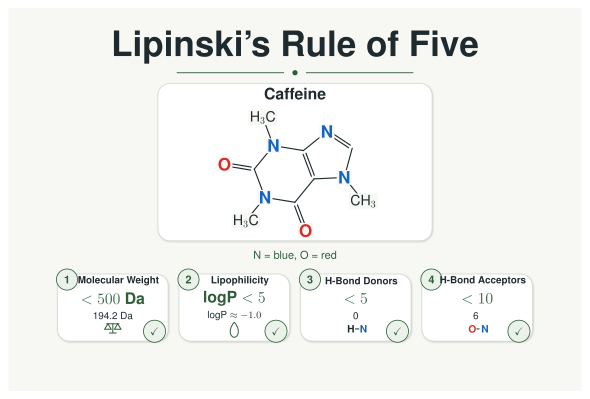
In medicinal chemistry, it is important to prioritize the most promising molecules in order to reduce experimental and computational costs. One of the simplest and most widely used heuristics for early-stage compound selection is Lipinski’s Rule of Five Lipinski et al., 1997, which describes four physicochemical criteria associated with favorable oral bioavailability.
1.1 Lipinski’s Rule of Five
Lipinski’s Rule of Five defines a set of empirical physicochemical criteria commonly used to assess whether a small molecule is likely to exhibit acceptable oral drug-like properties.
| Parameter | Recommended threshold | Physicochemical rationale |
|---|---|---|
| Hydrogen bond donors | ≤ 5 | Excessive donor capacity may reduce passive membrane permeability. |
| Hydrogen bond acceptors | ≤ 10 | High acceptor count is often associated with increased polarity and reduced intestinal absorption. |
| Molecular weight | ≤ 500 Da | Larger molecules generally show reduced passive diffusion across biological membranes. |
| logP | ≤ 5 | Excessive lipophilicity may impair aqueous solubility and pharmacokinetic behavior. |
Interpretation: Molecules satisfying these criteria are more likely to possess physicochemical properties compatible with oral absorption. However, the rule should be considered a prioritization heuristic rather than an absolute filter. Deviations may occur for specific chemical classes, including natural products, macrocycles, peptides, and compounds relying on active transport mechanisms.
from rdkit.Chem.Lipinski import NumHAcceptors, NumHDonors

nh_acc = NumHAcceptors(osimertinib)
nh_do = NumHDonors(osimertinib)
Q2
Compute the number of hydrogen bond donors and acceptors for each molecule in
mols.
Solution
from rdkit.Chem.Descriptors import NumHAcceptors, NumHDonors

nh_acc_mols = [NumHAcceptors(mol) for mol in mols]
nh_do_mols  = [NumHDonors(mol) for mol in mols]
We can now use the Lipinski function to filter molecules based on
Lipinski’s Rule of Five.
from rdkit.Chem.Crippen import MolLogP


def Lipinski(mol) -> bool:
    """
    Check whether a molecule satisfies Lipinski's Rule of Five.

    Parameters
    ----------
    mol : rdkit.Chem.Mol
        RDKit molecule object.

    Returns
    -------
    bool
        True if the molecule passes all Lipinski criteria, False otherwise.
    """
    if mol is None:
        return False

    mw = Descriptors.MolWt(mol)
    h_donors = Descriptors.NumHDonors(mol)
    h_acceptors = Descriptors.NumHAcceptors(mol)
    logp = MolLogP(mol)

    return mw <= 500 and h_donors <= 5 and h_acceptors <= 10 and logp <= 5


Lipinski(osimertinib)
Q3 — Lipinski filtering
Apply the Lipinski filter to the dataset and annotate the DataFrame with a pass/fail flag.
Solution
from rdkit import Chem

df["mol"] = df["smiles"].apply(Chem.MolFromSmiles)
df["Lipinski"] = df["mol"].apply(passes_lipinski)
Dataset-level property distributions
The four Lipinski properties computed across the full 1,000-molecule dataset. Dashed black lines mark the Rule of Five thresholds; bars are coloured by pass/fail status.
Source
from rdkit.Chem import Descriptors
from rdkit.Chem.Crippen import MolLogP
from rdkit.Chem.Lipinski import NumHDonors, NumHAcceptors

df["mol"] = df["smiles"].apply(Chem.MolFromSmiles)
df["MW"] = df["mol"].apply(lambda m: Descriptors.MolWt(m) if m else None)
df["LogP"] = df["mol"].apply(lambda m: MolLogP(m) if m else None)
df["HBD"] = df["mol"].apply(lambda m: NumHDonors(m) if m else None)
df["HBA"] = df["mol"].apply(lambda m: NumHAcceptors(m) if m else None)
df["Lipinski"] = df["mol"].apply(Lipinski)
df_vis = df.dropna(subset=["MW", "LogP", "HBD", "HBA"])

props = [
    ("MW", 500, "Molecular Weight (g/mol)"),
    ("LogP", 5, "LogP"),
    ("HBD", 5, "H-Bond Donors"),
    ("HBA", 10, "H-Bond Acceptors"),
]

fig, axes = plt.subplots(2, 2, figsize=(10, 7))
fig.suptitle(
    "Physicochemical properties — 1,000 molecules", fontsize=13, fontweight="bold"
)

for ax, (col, threshold, xlabel) in zip(axes.flat, props):
    pass_vals = df_vis.loc[df_vis["Lipinski"], col]
    fail_vals = df_vis.loc[~df_vis["Lipinski"], col]
    ax.hist(
        fail_vals,
        bins=35,
        color="#D62728",
        alpha=0.65,
        label="Fail RO5",
        edgecolor="white",
    )
    ax.hist(
        pass_vals,
        bins=35,
        color="#1F77B4",
        alpha=0.65,
        label="Pass RO5",
        edgecolor="white",
    )
    ax.axvline(
        threshold,
        color="black",
        linestyle="--",
        linewidth=1.8,
        label=f"Limit ({threshold})",
    )
    ax.set_xlabel(xlabel)
    ax.set_ylabel("Count")
    ax.legend(fontsize=8)
    ax.spines[["top", "right"]].set_visible(False)

plt.tight_layout()
plt.show()

pass_n = int(df_vis["Lipinski"].sum())
print(f"Lipinski pass: {pass_n} / {len(df_vis)}  ({pass_n/len(df_vis):.1%})")
Source
fig, ax = plt.subplots(figsize=(7, 5))

for passes, grp in df_vis.groupby("Lipinski"):
    label = "Pass RO5" if passes else "Fail RO5"
    color = "#1F77B4" if passes else "#D62728"
    ax.scatter(grp["MW"], grp["LogP"], label=label, alpha=0.45, s=12, color=color)

ax.axvline(500, color="gray", linestyle="--", linewidth=1.2, label="MW = 500")
ax.axhline(5, color="gray", linestyle=":", linewidth=1.2, label="LogP = 5")
ax.set_xlabel("Molecular Weight (g/mol)")
ax.set_ylabel("LogP")
ax.set_title("Chemical space — MW vs LogP")
ax.legend(fontsize=9)
ax.spines[["top", "right"]].set_visible(False)
plt.tight_layout()
plt.show()
2. SMILES
SMILES stands for Simplified Molecular Input Line Entry System
It is a compact, human-readable text notation that encodes a molecular graph, where:
| Graph concept | Molecular meaning | SMILES representation |
|---|---|---|
| Nodes | Atoms | C, N, O, Cl, [NH4+] |
| Edges | Bonds | implicit single bonds, =, # |
| Branches | Side chains | (...) |
| Cycles | Rings | matching digits such as 1...1 |
| Geometry | Stereochemistry | @, @@, /, \ |
2.1. Overview
SMILES encodes molecular structure using a small set of compact symbols.
C, N, O, ClAtoms are written using element symbols.
CC, C=C, C#NSingle bonds are usually implicit.
CC(O)CParentheses create side chains.
C1CCCCC1Matching digits close rings.
Token legend
| Token type | Example | Meaning |
|---|---|---|
| Aliphatic atom | C, N, O, Cl | Standard non-aromatic atoms |
| Aromatic atom | c, n, o | Aromatic atoms, usually lowercase |
| Double bond | = | Explicit double bond |
| Triple bond | # | Explicit triple bond |
| Branch | (...) | Side chain |
| Ring closure | 1, 2, %10 | Connects two atoms to form a ring |
| Stereochemistry | @, @@, /, \ | Chirality or double-bond geometry |
| Bracketed atom | [NH4+], [13C], [O-] | Explicit hydrogens, isotopes, charges, or uncommon valence |
Key rule:
SMILES is not just a string. It is a compact way to encode a molecular graph.
2.2. Atoms & bonds
Atoms are represented by element symbols such as C, N, O, and Cl.
Single bonds are usually implicit, while double and triple bonds are written explicitly.
| SMILES | Visual interpretation | Meaning |
|---|---|---|
C | C | methane carbon with implicit hydrogens |
CCO | C–C–O | ethanol-like fragment |
C=O | C=O | carbonyl double bond |
C#N | C≡N | triple bond |
[Na+] | Na⁺ | explicit sodium cation |
C      # methane carbon with implicit hydrogens
CCO    # ethanol fragment, C–C–O
C=O    # formaldehyde-like carbonyl
C#N    # hydrogen cyanide or nitrile-like triple bond
[Na+]  # explicit sodium cation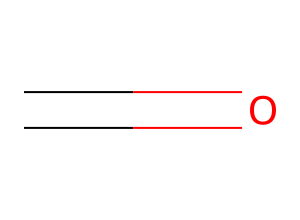
2.3. Branches
Parentheses create branches or side chains.
CCO       # linear chain
CC(O)C    # branch: hydroxyl on the middle carbon
C(C)(C)C  # tert-butyl-like branching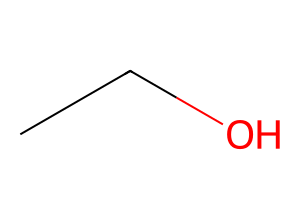
2.4. Rings
Ring closures use matching digits to connect two positions in the SMILES string.
C1CCCCC1      # cyclohexane
c1ccccc1      # benzene, aromatic SMILES
C1=CC=CC=C1   # benzene-like Kekulé notation
For ring labels above 9, use %.
C%10CCCCCCCCC%10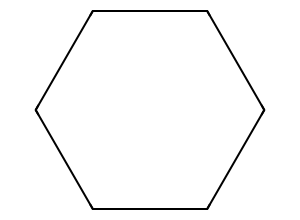
2.5. Aromaticity
Aromatic atoms are commonly written using lowercase letters.
| SMILES | Meaning |
|---|---|
c1ccccc1 | benzene |
n1ccccc1 | pyridine-like aromatic ring |
c1ccccc1   # benzene, aromatic
n1ccccc1   # pyridine-like aromatic ring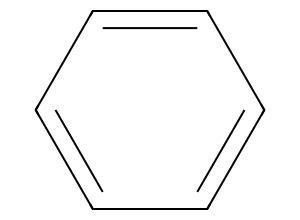
2.6. Stereochemistry
SMILES can encode stereochemical information.
| Notation | Used for | Example |
|---|---|---|
@ | tetrahedral chirality | C[C@H](O)Cl |
@@ | opposite tetrahedral configuration | C[C@
;(O)Cl |
/ and \ | double-bond geometry | C/C=C\C |
C[C@H](O)Cl      # chiral centre with explicit stereochemistry
C/C=C\C          # defined double-bond geometry
RDKit preserves stereochemical flags when parsing and writing SMILES with:
Chem.MolToSmiles(mol, isomericSmiles=True)Cl](/build/chiral_example-2286c3605ebd346e0c0f3626ecf99e52.svg)
2.7. Bracketed atoms & special cases
Brackets are used when the default SMILES rules are not enough.
Use brackets for:
| Case | Examples |
|---|---|
| explicit hydrogens | [NH2], [nH] |
| charges | [O-], [NH4+] |
| isotopes | [13C] |
| unusual valence states | [Fe+2], [Se] |
| explicit atom specification | [Cl], [Na+] |
c1ccccc1[NH2]     # aniline with explicit NH2
c1cc[nH]c1        # aromatic nitrogen with explicit H
CC(=O)[O-]        # acetate anion
[NH4+]            # ammonium cation
[NH4+].[Cl-]      # ammonium chloride, ionic pair
[13CH3]C(=O)O     # acetic acid with 13C-labelled methyl carbon
C[Se]C            # dimethyl selenide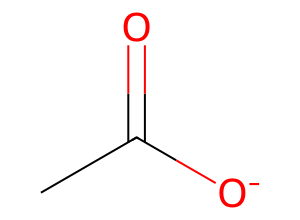
2.8. Common beginner mistakes
Click to expand common SMILES mistakes
| Mistake | Example | Why it matters |
|---|---|---|
| Confusing uppercase and lowercase atoms | C vs c | C is aliphatic, c is aromatic |
| Forgetting ring digit pairs | C1CCCC | ring closure is incomplete |
| Misplacing branches | CC(O)C vs CCC(O) | branches attach to the atom before ( |
| Ignoring stereochemistry | C[C@H](O)Cl vs CC(O)Cl | stereochemistry may change molecular identity |
| Overusing brackets | [C][C][O] | most common atoms do not need brackets |
| Missing charge notation | [O-] vs O | charged and neutral atoms are different |
2.9. Summary
SMILES is compact because it relies on a small set of rules:
| Feature | Main notation |
|---|---|
| Atoms | C, N, O, Cl |
| Aromatic atoms | lowercase, e.g. c, n |
| Single bonds | usually implicit |
| Double bonds | = |
| Triple bonds | # |
| Branches | (...) |
| Rings | matching digits, e.g. 1...1 |
| Charges/isotopes/explicit H | brackets, e.g. [NH4+], [13C] |
| Stereochemistry | @, @@, /, \ |
Now experiment with some examples
The cell below color-codes each SMILES token by its syntactic role — useful for parsing unfamiliar strings. Each color corresponds to a token class (aromatic atom, branch, ring closure, stereo, etc.).
Source
import re
import html
from collections import Counter
from IPython.display import HTML, display
from synedu.Utils.vis import render_smiles_annotation


_TOKEN_PATTERNS = [
    (r"\[[^\]]+\]", "Bracketed atom / group", "#2CA02C", "#EAF7EA"),
    (r"%\d{2}|\d", "Ring closure", "#E377C2", "#FCEAF7"),
    (r"[cnops]", "Aromatic atom", "#1F77B4", "#EAF2FB"),
    (r"[A-Z][a-z]?", "Aliphatic atom", "#4D4D4D", "#F0F0F0"),
    (r"=", "Double bond", "#D62728", "#FDECEC"),
    (r"#", "Triple bond", "#8C564B", "#F3ECE9"),
    (r"-", "Single bond", "#7F7F7F", "#F2F2F2"),
    (r"[()]", "Branch", "#FF7F0E", "#FFF1E5"),
    (r"[@/\\]", "Stereo", "#9467BD", "#F3ECFA"),
    (r"\.", "Disconnected component", "#17BECF", "#E7F9FB"),
]


def tokenize_smiles(smiles: str):
    tokens = []
    i = 0

    while i < len(smiles):
        remaining = smiles[i:]

        for pattern, label, color, bg in _TOKEN_PATTERNS:
            m = re.match(pattern, remaining)
            if m:
                tok = m.group(0)
                tokens.append(
                    {
                        "text": tok,
                        "label": label,
                        "color": color,
                        "bg": bg,
                        "start": i,
                        "end": i + len(tok) - 1,
                    }
                )
                i += len(tok)
                break
        else:
            tokens.append(
                {
                    "text": remaining[0],
                    "label": "Other",
                    "color": "#111111",
                    "bg": "#FFFFFF",
                    "start": i,
                    "end": i,
                }
            )
            i += 1

    return tokens


def annotate_smiles_html(
    smiles: str, title: str | None = None, show_indices: bool = True
) -> str:
    tokens = tokenize_smiles(smiles)
    counts = Counter(t["label"] for t in tokens)

    token_html = ""
    index_html = ""

    for t in tokens:
        safe_tok = html.escape(t["text"])

        token_html += f"""
        <span class="smi-token"
              title="{html.escape(t['label'])}: position {t['start']}"
              style="
                color:{t['color']};
                background:{t['bg']};
                border:1px solid {t['color']}55;
              ">
            {safe_tok}
        </span>
        """

        if show_indices:
            idx = str(t["start"]) if len(t["text"]) == 1 else f"{t['start']}-{t['end']}"
            index_html += f"""
            <span class="smi-index">{idx}</span>
            """

    legend_items = []
    seen = {}

    for t in tokens:
        if t["label"] not in seen:
            seen[t["label"]] = (t["color"], t["bg"])

    for label, (color, bg) in seen.items():
        legend_items.append(
            f"""
            <span class="smi-legend-item" style="background:{bg};border-color:{color}55">
                <span style="color:{color};font-weight:800">■</span>
                {html.escape(label)}
                <span class="smi-count">{counts[label]}</span>
            </span>
            """
        )

    title_html = ""
    if title:
        title_html = f"""
        <div class="smi-title">
            {html.escape(title)}
        </div>
        """

    return f"""
    <style>
        .smi-card {{
            font-family: Inter, system-ui, -apple-system, BlinkMacSystemFont, "Segoe UI", sans-serif;
            border: 1px solid #E5E7EB;
            border-radius: 14px;
            padding: 14px 16px;
            margin: 12px 0;
            background: linear-gradient(180deg, #FFFFFF 0%, #FAFAFA 100%);
            box-shadow: 0 4px 14px rgba(0,0,0,0.06);
            max-width: 920px;
        }}

        .smi-title {{
            font-weight: 750;
            font-size: 15px;
            margin-bottom: 8px;
            color: #111827;
        }}

        .smi-raw {{
            font-family: ui-monospace, SFMono-Regular, Menlo, Consolas, monospace;
            font-size: 12px;
            color: #6B7280;
            margin-bottom: 10px;
            word-break: break-all;
        }}

        .smi-token-row {{
            display: flex;
            flex-wrap: wrap;
            gap: 5px;
            align-items: center;
            margin-bottom: 6px;
        }}

        .smi-token {{
            font-family: ui-monospace, SFMono-Regular, Menlo, Consolas, monospace;
            font-weight: 800;
            font-size: 18px;
            line-height: 1.2;
            padding: 5px 7px;
            border-radius: 8px;
            display: inline-block;
            transition: transform 0.12s ease, box-shadow 0.12s ease;
        }}

        .smi-token:hover {{
            transform: translateY(-2px) scale(1.05);
            box-shadow: 0 4px 10px rgba(0,0,0,0.12);
            cursor: help;
        }}

        .smi-index-row {{
            display: flex;
            flex-wrap: wrap;
            gap: 5px;
            margin-bottom: 12px;
        }}

        .smi-index {{
            font-family: ui-monospace, SFMono-Regular, Menlo, Consolas, monospace;
            color: #9CA3AF;
            background: #F9FAFB;
            border: 1px solid #E5E7EB;
            border-radius: 6px;
            padding: 2px 6px;
            font-size: 10px;
            min-width: 18px;
            text-align: center;
        }}

        .smi-legend {{
            display: flex;
            flex-wrap: wrap;
            gap: 7px;
            margin-top: 10px;
        }}

        .smi-legend-item {{
            border: 1px solid;
            border-radius: 999px;
            padding: 4px 9px;
            font-size: 12px;
            color: #374151;
            display: inline-flex;
            align-items: center;
            gap: 5px;
        }}

        .smi-count {{
            color: #6B7280;
            background: #FFFFFFAA;
            border-radius: 999px;
            padding: 1px 6px;
            font-size: 11px;
            font-weight: 700;
        }}
    </style>

    <div class="smi-card">
        {title_html}

        <div class="smi-raw">
            Raw SMILES: {html.escape(smiles)}
        </div>

        <div class="smi-token-row">
            {token_html}
        </div>

        {f'<div class="smi-index-row">{index_html}</div>' if show_indices else ''}

        <div class="smi-legend">
            {''.join(legend_items)}
        </div>
    </div>
    """


examples = [
    ("Aspirin", "CC(=O)Oc1ccccc1C(=O)O"),
    ("Chiral", "C[C@H](O)Cl"),
    ("Pyrrole", "c1cc[nH]c1"),
    ("Ionic pair", "[Na+].[Cl-]"),
    ("Nitrile", "C#N"),
]

for name, smi in examples:
    display(HTML(render_smiles_annotation(smi, title=name)))
SMILES strings can have many valid variants for the same molecule Weininger et al., 1989.
Source
from rdkit.Chem import Draw

s1 = "CC(=O)Oc1ccccc1C(=O)O"
s2 = "O=C(O)c1ccccc1OC(=O)C"

m1 = Chem.MolFromSmiles(s1)
m2 = Chem.MolFromSmiles(s2)

Draw.MolsToGridImage([m1, m2], molsPerRow=2, subImgSize=(600, 200))
The simplest and most reliable way to compare or normalise SMILES is to convert them to a canonical form in RDKit RDKit, 2026Weininger et al., 1989Morgan, 1965.
can1 = Chem.CanonSmiles(s1)
can2 = Chem.CanonSmiles(s2)
print("canonical 1:", can1)
print("canonical 2:", can2)
print("same SMILES?", can1 == can2)

m1 = Chem.MolFromSmiles(can1)
m2 = Chem.MolFromSmiles(can2)

Draw.MolsToGridImage([m1, m2], molsPerRow=2, subImgSize=(600, 200))
Graph canonicalization (canonical SMILES, toolkit differences) will be covered in later talktorials (S06).
3. Molecular Graph representation
In computational reaction modeling, we represent molecules as labeled graphs so that any notion of “matching” respects chemical identity, such as element type, charge, and bond order, rather than bare connectivity alone Bonchev & Rouvray, 1991.
A labeled molecular graph is a quadruple
where:
Vertices represent atoms.
Edges represent bonds (finite, undirected, simple: no loops, no parallel edges).
: atom-labeling function.
: bond-labeling function.
We often write and for the vertex and edge sets of . For a vertex :
neighborhood:
degree:
These graph-theoretic notions correspond chemically to an atom’s bonded neighbors and coordination number, abstracting away geometry while retaining connectivity.
3.1. Labels and chemical types
Attributes are encoded via explicit labelling maps
where and are finite, non-empty label sets. For molecular graphs, we use the chemistry-specific notation:
Let denote the class of all labelled molecular graphs equipped with . In chemistry, encodes what atom this is (element, charge, aromaticity, hydrogen count, …), while encodes what bond this is (order, aromaticity, ring status, …).
All subsequent notions of equivalence, symmetry, and matching in this talktorial are defined relative to these labels.
3.2. Graph representations in practice
In SynEdu, RDKit and NetworkX play complementary roles:
RDKit is the chemical authority: sanitization, valence rules, aromaticity perception, and canonicalization.
NetworkX provides an explicit, inspectable graph representation used for matching, symmetry analysis, and later graph rewriting.
To ensure that graph-based operations remain chemically meaningful, we require a reversible interface for the attributes represented by the graph schema. Element, formal charge, aromaticity, hydrogen count, atom maps, and bond order are retained here. Isotopes and stereochemical tags are not yet part of this schema, so it is not a lossless serialization of every RDKit molecular feature.
This reversible interface forms the foundation for all later notions—graph isomorphism, automorphisms, and eventually reaction rules—introduced in subsequent SynEdu notebooks.
Definition (Labeled Molecular Graph).
A labeled molecular graph is a 4-tuple
where is the set of represented atoms (normally heavy atoms, with hydrogens stored implicitly), is the set of covalent bonds (undirected edges), assigns each atom a tuple of node attributes (element symbol, formal charge, aromaticity, hydrogen count, atom-map number), and assigns each bond a tuple of edge attributes (bond order, aromaticity).
A labeled graph homomorphism is a vertex map such that every edge maps to the edge , with and . The edge map is therefore induced by the vertex map rather than specified independently.
Remark. The attribute schema used throughout SynEdu isa(v) = (element, formal_charge, aromatic, hcount, atom_map) and b(e) = (order, aromatic).
Hydrogen atoms are stored implicitly in hcount to keep graphs small.
from typing import Dict, Any
import networkx as nx
from rdkit import Chem
def mol_to_graph(
mol: Chem.Mol,
drop_non_aam: bool = False,
use_index_as_atom_map: bool = False,
) -> nx.Graph:
"""
Convert an RDKit Mol to a lightweight heavy-atom NetworkX graph.
:param mol: RDKit molecule.
:type mol: rdkit.Chem.Mol
:param drop_non_aam: If True, skip atoms that carry no atom-map number.
:type drop_non_aam: bool
:param use_index_as_atom_map: If True, use atom index as node ID and set
``atom_map`` attribute to the index. If False, use atom-map number
when present, falling back to a unique atom index.
:type use_index_as_atom_map: bool
:returns: Graph with element/formal_charge/aromatic/hcount/atom_map node
attributes and order/aromatic edge attributes.
:rtype: networkx.Graph
"""
G: nx.Graph = nx.Graph()
local: Dict[int, Any] = {}
# Existing atom-map numbers, used to avoid collisions with fallback IDs
used_aam = {
atom.GetAtomMapNum() for atom in mol.GetAtoms() if atom.GetAtomMapNum() > 0
}
next_fallback_id = 1
def get_unique_fallback_id() -> int:
nonlocal next_fallback_id
while next_fallback_id in used_aam:
next_fallback_id += 1
out = next_fallback_id
used_aam.add(out)
next_fallback_id += 1
return out
for atom in mol.GetAtoms():
atom_idx = atom.GetIdx()
am = int(atom.GetAtomMapNum())
if drop_non_aam and am == 0:
continue
if use_index_as_atom_map:
node_id = atom_idx + 1
node_am = atom_idx + 1
elif am > 0:
node_id = am
node_am = am
else:
node_id = get_unique_fallback_id()
node_am = 0
local[atom_idx] = node_id
G.add_node(
node_id,
element=atom.GetSymbol(),
formal_charge=int(atom.GetFormalCharge()),
aromatic=bool(atom.GetIsAromatic()),
hcount=int(atom.GetTotalNumHs()),
atom_map=node_am,
)
for bond in mol.GetBonds():
u = local.get(bond.GetBeginAtomIdx())
v = local.get(bond.GetEndAtomIdx())
if u is None or v is None:
continue
G.add_edge(
u,
v,
order=float(bond.GetBondTypeAsDouble()),
aromatic=bool(bond.GetIsAromatic()),
)
return GGraph attribute inspection
The DataFrames below show the concrete realization of the label functions (node attributes) and (edge attributes) for phenol. This makes explicit what information is stored — and therefore what is available for downstream matching and rewriting.
mol_ex = Chem.MolFromSmiles(Chem.CanonSmiles("c1ccccc1O"))  # phenol
G_ex = mol_to_graph(mol_ex)

node_df = pd.DataFrame(
    [{"node_id": n, **d} for n, d in sorted(G_ex.nodes(data=True))]
).set_index("node_id")

edge_df = pd.DataFrame([{"u": u, "v": v, **d} for u, v, d in G_ex.edges(data=True)])

print("Node attributes  (a_G — atom labels) — phenol:")
display(node_df)
print("\nEdge attributes  (b_G — bond labels) — phenol:")
display(edge_df)
def graph_to_mol(
G: nx.Graph,
sanitize: bool = True,
use_h_count: bool = False,
use_atom_map: bool = True,
preserve_aromatic: bool = True,
) -> Chem.Mol:
"""
Reconstruct an RDKit Mol from a NetworkX graph.
Supports:
- element
- formal_charge
- atom_map
- bond order
- aromatic bonds
- optional explicit H count
"""
rw = Chem.RWMol()
node_to_idx: Dict[Any, int] = {}
for node, data in G.nodes(data=True):
element = data.get("element", "C")
charge = int(data.get("formal_charge", 0))
atom = Chem.Atom(element)
atom.SetFormalCharge(charge)
if use_atom_map:
am = int(data.get("atom_map", 0) or 0)
if am:
atom.SetAtomMapNum(am)
atom.SetIsAromatic(False)
idx = rw.AddAtom(atom)
node_to_idx[node] = idx
for u, v, data in G.edges(data=True):
i = node_to_idx[u]
j = node_to_idx[v]
if preserve_aromatic and bool(data.get("aromatic", False)):
btype = Chem.BondType.AROMATIC
else:
try:
order = int(round(abs(float(data.get("order", 1.0)))))
except Exception:
order = 1
btype = {
1: Chem.BondType.SINGLE,
2: Chem.BondType.DOUBLE,
3: Chem.BondType.TRIPLE,
}.get(order, Chem.BondType.SINGLE)
rw.AddBond(i, j, btype)
if use_h_count:
for node, data in G.nodes(data=True):
try:
n_h = int(data.get("hcount", 0))
except Exception:
continue
if n_h <= 0:
continue
atom = rw.GetAtomWithIdx(node_to_idx[node])
atom.SetNoImplicit(True)
atom.SetNumExplicitHs(n_h)
mol = rw.GetMol()
if sanitize:
Chem.SanitizeMol(
mol,
sanitizeOps=Chem.SanitizeFlags.SANITIZE_ALL
^ Chem.SanitizeFlags.SANITIZE_SETAROMATICITY
^ Chem.SanitizeFlags.SANITIZE_KEKULIZE,
)
Chem.SetAromaticity(mol)
return molStored in
synedu.Utils— bothmol_to_graphandgraph_to_mol(defined above) are packaged insynedu.Utils.conversionso every later talktorial can import them without redefining them:from synedu.Utils.conversion import mol_to_graph, graph_to_mol
smiles_to_graphandgraph_to_smi(thin wrappers around these) are available there too.
s = Chem.CanonSmiles("c1ccccc1O")
m = Chem.MolFromSmiles(s)
G = mol_to_graph(m)
m1 = graph_to_mol(G)
s1 = Chem.MolToSmiles(m1, canonical=True)
print("Is consistent:", s == s1)

draw_molecular_graph(G, include_mol=True, label_mode="hetero", aromatic_style="circle")
plt.show()
Kekulé vs aromatic — graph label differences
The same molecule (benzene) written in two SMILES notations produces different bond-order labels in the graph:
Kekulé (
C1=CC=CC=C1): alternating single (1.0) and double (2.0) bonds.Aromatic (
c1ccccc1): uniform aromatic bonds (order 1.5), with anaromatic=Trueflag on all nodes and edges.
This distinction matters for graph isomorphism and reaction rule matching in later notebooks.
Source
from rdkit.Chem import Draw

kekule_smi = "C1=CC=CC=C1"  # Kekulé benzene
aromatic_smi = "c1ccccc1"  # aromatic benzene

mol_kek = Chem.MolFromSmiles(kekule_smi)
Chem.Kekulize(
    mol_kek, clearAromaticFlags=True
)  # forces alternating 1/2 bonds, clears aromatic flags

mol_arom = Chem.MolFromSmiles(aromatic_smi)
G_kek = mol_to_graph(mol_kek)
G_arom = mol_to_graph(mol_arom)

fig, axes = plt.subplots(1, 4, figsize=(16, 4))
fig.suptitle(
    "Kekulé vs aromatic SMILES — effect on graph edge labels",
    fontsize=12,
    fontweight="bold",
)

for col, mol, G, title_mol, title_g in [
    (
        0,
        mol_kek,
        G_kek,
        f"Kekulé\n{kekule_smi}",
        "Graph: alternating\nsingle/double bonds",
    ),
    (
        2,
        mol_arom,
        G_arom,
        f"Aromatic\n{aromatic_smi}",
        "Graph: aromatic bonds\n(circle notation)",
    ),
]:
    axes[col].imshow(Draw.MolToImage(mol, size=(300, 300)))
    axes[col].set_title(title_mol, fontsize=10)
    axes[col].axis("off")
    draw_molecular_graph(G, ax=axes[col + 1], label_mode="all", aromatic_style="circle")
    axes[col + 1].set_title(title_g, fontsize=9)

plt.tight_layout()
plt.show()

print(
    "Kekulé  bond orders: ",
    sorted(set(d["order"] for _, _, d in G_kek.edges(data=True))),
)
print(
    "Aromatic bond orders:",
    sorted(set(d["order"] for _, _, d in G_arom.edges(data=True))),
)
print(
    "Aromatic node flags: ",
    sorted(set(d["aromatic"] for _, d in G_arom.nodes(data=True))),
)
3.3. Matrix representations
A labeled molecular graph can be encoded as several matrices, each capturing a different structural aspect Bonchev & Rouvray, 1991Wiener, 1947Dugundji & Ugi, 1973:
| Matrix | Shape | Entry meaning |
|---|---|---|
| Adjacency | = bond order between atoms and | |
| Distance | = shortest-path length (in bonds) between and | |
| Incidence | if atom participates in bond | |
| Bond-Electron | off-diagonal = bond order; diagonal = free (nonbonding) electrons |
The BE matrix generalizes the adjacency matrix by placing free-electron counts on the diagonal. For a fully atom-mapped reaction, the difference records the formal bond-order and free-electron changes represented by this model. It is not a quantum-mechanical description of the transition state; the reaction-level bookkeeping is developed in S04.
Adjacency
The adjacency matrix encodes pairwise atom connectivity. Three variants are informative:
| Panel | Entry | When useful |
|---|---|---|
| Binary | 1 if bond exists, else 0 | Connectivity-only algorithms (BFS, diameter) |
| Weighted — aromatic | Bond order from aromatic SMILES (1.5 for ring bonds) | Aromatic-aware descriptors |
| Weighted — Kekulé | Bond order from Kekulé SMILES (1.0 or 2.0) | Reaction-rule matching, BE matrix |
Key properties shared by all variants:
Symmetric: (undirected bonds)
Zero diagonal: no self-loops ()
Diagonal entries of the degree matrix give the heavy-atom degree of each atom
Source
import numpy as np

# Aromatic form: ring bonds have order 1.5
mol_arom = Chem.MolFromSmiles(Chem.CanonSmiles("c1ccccc1O"))

# Kekulé form: ring bonds alternate 1.0 / 2.0
mol_kek = Chem.RWMol(Chem.MolFromSmiles("c1ccccc1O"))
Chem.Kekulize(mol_kek, clearAromaticFlags=True)

G_arom = mol_to_graph(mol_arom)
G_kek = mol_to_graph(mol_kek)

ordered = sorted(G_arom.nodes())
tick = [f"{G_arom.nodes[n]['element']}{n}" for n in ordered]

A_bin = (
    nx.to_numpy_array(G_arom, nodelist=ordered, weight="order", nonedge=0.0) > 0
).astype(float)
A_arom = nx.to_numpy_array(G_arom, nodelist=ordered, weight="order", nonedge=0.0)
A_kek = nx.to_numpy_array(G_kek, nodelist=ordered, weight="order", nonedge=0.0)


def _adj_panel(ax, A, tick, title, cmap, vmax, fmt_fn):
    im = ax.imshow(A, cmap=cmap, vmin=0, vmax=vmax)
    n = len(tick)
    ax.set_xticks(range(n))
    ax.set_xticklabels(tick, fontsize=8)
    ax.set_yticks(range(n))
    ax.set_yticklabels(tick, fontsize=8)
    for i in range(n):
        for j in range(n):
            if A[i, j] > 0:
                ax.text(
                    j,
                    i,
                    fmt_fn(A[i, j]),
                    ha="center",
                    va="center",
                    fontsize=7,
                    color="black",
                )
    plt.colorbar(im, ax=ax, fraction=0.046, pad=0.04)
    ax.set_title(title, fontsize=9, fontweight="bold", pad=6)


fig, axes = plt.subplots(1, 3, figsize=(15, 4.5))
fig.suptitle("Adjacency matrix — phenol", fontsize=13, fontweight="bold")

_adj_panel(
    axes[0], A_bin, tick, "Binary\n(0 / 1 connectivity)", "Greys", 1, lambda v: "1"
)
_adj_panel(
    axes[1],
    A_arom,
    tick,
    "Weighted — aromatic SMILES\n(ring bonds = 1.5)",
    "YlOrRd",
    2,
    lambda v: f"{v:.1f}",
)
_adj_panel(
    axes[2],
    A_kek,
    tick,
    "Weighted — Kekulé SMILES\n(ring bonds = 1 / 2)",
    "YlOrRd",
    2,
    lambda v: f"{v:.0f}",
)

plt.tight_layout()
plt.show()

print(
    "Aromatic ring bond orders:",
    sorted(set(d["order"] for _, _, d in G_arom.edges(data=True))),
)
print(
    "Kekulé  ring bond orders: ",
    sorted(set(d["order"] for _, _, d in G_kek.edges(data=True))),
)
Distance matrix
For a connected molecular graph, the topological distance matrix records the shortest-path length (measured in bonds) between every pair of atoms. is the minimum number of bonds to traverse to reach atom from atom , computed via Floyd–Warshall or breadth-first search on the unweighted graph.
Key properties:
Zero diagonal:
Symmetric:
The graph diameter is the longest shortest path — a compact measure of molecular “stretch”
Distance-based Wiener index correlates with boiling points for alkanes Wiener, 1947
For a disconnected multi-component graph, cross-component distances are infinite and the ordinary graph diameter and Wiener index above are undefined; compute them component by component instead.
Source
import numpy as np

mol_dist = Chem.MolFromSmiles(Chem.CanonSmiles("c1ccccc1O"))  # phenol
G_dist = mol_to_graph(mol_dist)

ordered_dist = sorted(G_dist.nodes())
tick_dist = [f"{G_dist.nodes[n]['element']}{n}" for n in ordered_dist]
D = nx.floyd_warshall_numpy(G_dist, nodelist=ordered_dist)

fig, ax = plt.subplots(figsize=(5, 4.5))
im = ax.imshow(D, cmap="Blues")
ax.set_xticks(range(len(tick_dist)))
ax.set_xticklabels(tick_dist, fontsize=9)
ax.set_yticks(range(len(tick_dist)))
ax.set_yticklabels(tick_dist, fontsize=9)

for i in range(len(ordered_dist)):
    for j in range(len(ordered_dist)):
        ax.text(
            j,
            i,
            int(D[i, j]),
            ha="center",
            va="center",
            fontsize=8,
            color="white" if D[i, j] > 2.5 else "black",
        )

plt.colorbar(im, ax=ax, fraction=0.046, label="Topological distance (bonds)")
ax.set_title("Topological distance matrix — phenol\n(shortest-path, unweighted)")
plt.tight_layout()
plt.show()

# diameter = longest shortest path in the molecule
print(f"Graph diameter (eccentricity max): {int(D.max())} bonds")
Incidence matrix
The node-edge incidence matrix maps atoms to bonds: if atom participates in bond , and 0 otherwise.
Key properties:
Each column has exactly two 1s (every bond connects exactly two atoms)
Each row sum equals the heavy-atom degree of that atom (not its bond-order valence)
, where is the diagonal degree matrix and is the binary adjacency matrix — a fundamental identity in algebraic graph theory
Incidence matrices appear in spectral graph theory and in the cycle-space formulation of Kirchhoff’s current laws Biggs, 1993
import numpy as np

mol_inc = Chem.MolFromSmiles(Chem.CanonSmiles("c1ccccc1O"))  # phenol
G_inc = mol_to_graph(mol_inc)

ordered_nodes = sorted(G_inc.nodes())
ordered_edges = list(G_inc.edges())
n_atoms = len(ordered_nodes)
n_bonds = len(ordered_edges)
atom_idx = {node: i for i, node in enumerate(ordered_nodes)}

B_inc = np.zeros((n_atoms, n_bonds), dtype=int)
for j, (u, v) in enumerate(ordered_edges):
    B_inc[atom_idx[u], j] = 1
    B_inc[atom_idx[v], j] = 1

atom_labels = [f"{G_inc.nodes[n]['element']}{n}" for n in ordered_nodes]
bond_labels = [f"b{j}" for j in range(n_bonds)]

fig, ax = plt.subplots(figsize=(9, 4))
im = ax.imshow(B_inc, cmap="Greys", vmin=0, vmax=1, aspect="auto")
ax.set_xticks(range(n_bonds))
ax.set_xticklabels(bond_labels, fontsize=8)
ax.set_yticks(range(n_atoms))
ax.set_yticklabels(atom_labels, fontsize=9)
ax.set_xlabel("Bonds")
ax.set_ylabel("Atoms")

for i in range(n_atoms):
    for j in range(n_bonds):
        ax.text(
            j,
            i,
            B_inc[i, j],
            ha="center",
            va="center",
            fontsize=8,
            color="white" if B_inc[i, j] else "#cccccc",
        )

ax.set_title(
    "Incidence matrix — phenol  (atoms × bonds)  |  B[i,j] = 1 if atom i ∈ bond j"
)
plt.tight_layout()
plt.show()

print(f"Matrix shape: {n_atoms} atoms × {n_bonds} bonds")
print(
    f"Row sums (degree in heavy-atom graph): { {atom_labels[i]: int(B_inc[i].sum()) for i in range(n_atoms)} }"
)
Bond-electron matrix
The Bond-Electron (BE) matrix extends the weighted adjacency matrix by encoding electron counts on the diagonal Dugundji & Ugi, 1973:
where is the valence electron count, the formal charge, and the implicit hydrogen count.
Aromatic vs Kekulé — two panels below highlight a key practical concern:
In the aromatic form, ring bond orders are 1.5, giving fractional diagonal values that have no physical meaning.
In the Kekulé form, all bond orders are integers, and the diagonal is a well-defined electron count.
The helper below is a closed-shell teaching approximation: it uses a finite main-group valence table and clamps negative diagonal estimates to zero. It should not be interpreted as an electronic-structure model for radicals, unusual hypervalent species, or transition metals. For ordinary organic reactions, a Kekulé BE matrix avoids fractional aromatic entries Dugundji & Ugi, 1973. The reaction-level version — the ΔBE matrix — is developed in S04.
import numpy as np

_VALENCE_ELECTRONS = {
    "H": 1,
    "C": 4,
    "N": 5,
    "O": 6,
    "F": 7,
    "P": 5,
    "S": 6,
    "Cl": 7,
    "Br": 7,
    "I": 7,
    "Si": 4,
    "B": 3,
}


def build_be_matrix(G: nx.Graph):
    ordered = sorted(G.nodes())
    idx = {node: i for i, node in enumerate(ordered)}
    n = len(ordered)
    B = np.zeros((n, n))

    for u, v, data in G.edges(data=True):
        order = float(data.get("order", 1.0))
        B[idx[u], idx[v]] = order
        B[idx[v], idx[u]] = order

    for node, data in G.nodes(data=True):
        el = data.get("element", "C")
        charge = int(data.get("formal_charge", 0))
        hcount = int(data.get("hcount", 0))
        val_e = _VALENCE_ELECTRONS.get(el, 0)
        bond_e = (
            sum(
                float(G.edges[node, nbr].get("order", 1.0)) for nbr in G.neighbors(node)
            )
            + hcount
        )
        B[idx[node], idx[node]] = max(val_e - charge - bond_e, 0)

    return B, ordered


# Aromatic form: ring bonds = 1.5
mol_be_arom = Chem.MolFromSmiles(Chem.CanonSmiles("c1ccccc1O"))

# Kekulé form: ring bonds = 1.0 / 2.0
mol_be_kek = Chem.MolFromSmiles(Chem.CanonSmiles("c1ccccc1O"))
Chem.Kekulize(mol_be_kek, clearAromaticFlags=True)

G_be_arom = mol_to_graph(mol_be_arom)
G_be_kek = mol_to_graph(mol_be_kek)

B_arom, ord_arom = build_be_matrix(G_be_arom)
B_kek, ord_kek = build_be_matrix(G_be_kek)


def _be_panel(ax, B, ordered, G, title):
    tick = [f"{G.nodes[n]['element']}{n}" for n in ordered]
    im = ax.imshow(B, cmap="PuBu", vmin=0)
    n = len(tick)
    ax.set_xticks(range(n))
    ax.set_xticklabels(tick, fontsize=9)
    ax.set_yticks(range(n))
    ax.set_yticklabels(tick, fontsize=9)
    for i in range(n):
        for j in range(n):
            val = B[i, j]
            if val > 0:
                ax.text(
                    j,
                    i,
                    f"{val:.1f}",
                    ha="center",
                    va="center",
                    fontsize=7,
                    color="white" if val > 3 else "black",
                )
    plt.colorbar(im, ax=ax, fraction=0.046, pad=0.04, label="Electrons")
    ax.set_title(title, fontsize=14, fontweight="bold", pad=6)


fig, axes = plt.subplots(1, 2, figsize=(11, 4.5))
fig.suptitle("Bond-electron (BE) matrix — phenol", fontsize=13, fontweight="bold")

_be_panel(
    axes[0],
    B_arom,
    ord_arom,
    G_be_arom,
    "Aromatic",
)
_be_panel(
    axes[1],
    B_kek,
    ord_kek,
    G_be_kek,
    "Kekulé",
)

plt.tight_layout()
plt.show()

print(f"{'Atom':>5}  {'Aromatic diag':>14}  {'Kekulé diag':>11}")
for n_a, n_k, v_a, v_k in zip(
    [f"{G_be_arom.nodes[n]['element']}{n}" for n in ord_arom],
    [f"{G_be_kek.nodes[n]['element']}{n}" for n in ord_kek],
    B_arom.diagonal(),
    B_kek.diagonal(),
):
    print(f"  {n_a:>4s}  {v_a:>14.2f}  {v_k:>11.1f}")
Stored in
synedu.Utils—build_be_matrixis also packaged for later graph-representation tasks:from synedu.Utils.graph import build_be_matrixLater notebooks can reuse the same bond-electron matrix convention instead of redefining it.
Q4 — Conversion
Goal
Convert the SMILES below to a graph and back to SMILES.
Explain why the round-trip fails.
smiles = "c1cc[nH]c1"Solution
from rdkit import Chem

def naive_roundtrip(smiles: str) -> str:
    mol = Chem.MolFromSmiles(smiles)
    G = mol_to_graph(mol)
    mol2 = graph_to_mol(G)
    return Chem.MolToSmiles(mol2, canonical=True)

naive_roundtrip("c1cc[nH]c1")
>> 'c1ccnc1'
Why it fails
[nH]is an aromatic nitrogen with an explicit hydrogenHeavy-atom graphs discard hydrogens
RDKit cannot recover this on rebuild:
[nH] → [n]This is information loss by representation, not a bug
Conclusion: Heavy-atom graphs are not information-complete for SMILES round-trip.
Since the hydrogen count is already stored in the graph (hcount), it can be
propagated back during molecule reconstruction:
for node, data in G.nodes(data=True):
    n_h = int(data.get("hcount", 0))
    heavy_atom.SetNoImplicit(True)
    heavy_atom.SetNumExplicitHs(n_h)
This logic is exposed via:
graph_to_mol(G, use_hcount=True)With use_hcount=True, explicit hydrogens (e.g. [nH]) are preserved, making the
SMILES round-trip reversible.
from rdkit import Chem


def roundtrip(smiles: str) -> str:
    mol = Chem.MolFromSmiles(smiles)
    G = mol_to_graph(mol)
    mol2 = graph_to_mol(G, use_h_count=True)
    return Chem.MolToSmiles(mol2, canonical=True)


roundtrip("c1cc[nH]c1")
Q5 — Round-trip conversion
Goal. Verify that SMILES in a DataFrame survive a
SMILES → RDKit → graph → RDKit round-trip without losing heavy-atom information.
Input. A DataFrame df with:
smiles: SMILES stringname: molecule name
Task.
Implement
roundtrip_smiles_equal(smiles)that:parses a SMILES with RDKit,
converts it to a labeled graph (
mol_to_graph),reconstructs a molecule (
graph_to_mol),compares canonical heavy-atom SMILES (hydrogens removed).
Apply it to
df["smiles"].Report molecules that fail the round-trip (if any).
Solution
def standardize(smiles):
    return Chem.CanonSmiles(smiles, useChiral=False)


def roundtrip_smiles_equal(smiles: str) -> bool:
    new_smiles = roundtrip(smiles)
    return (
        standardize(new_smiles) == standardize(smiles))

df["ok"] = df["smiles"].apply(roundtrip_smiles_equal)
df.loc[~df["ok"], ["name", "smiles"]]
4. Discussion
A labeled graph homomorphism provides a precise abstraction for structure- and attribute-preserving mappings between labeled graphs. A homomorphism need not be injective or surjective, so it does not by itself capture “sameness.” That stronger notion is a graph isomorphism — a bijective, structure- and label-preserving map whose inverse is also structure- and label-preserving — which underlies graph matching and is revisited in later SynEdu talktorials.
Our labeled molecular graph adopts a deliberately minimal attribute schema (
element,formal_charge,aromatic,hcount,atom_map,order). This strikes a balance between chemical faithfulness and algorithmic tractability: too few labels induce spurious symmetries, while too many hinder matching and reuse.Round-trip conversion (RDKit → NetworkX → RDKit) serves as a practical validation tool. While exact RDKit internal states need not be preserved, maintaining heavy-atom topology and labels ensures semantic equivalence and reproducibility.
5. Quiz
Answer briefly using what you learned about RDKit, SMILES, and molecular graphs.
What does RDKit molecule sanitization check, and why is it useful before graph conversion?
Why can one molecule have multiple valid SMILES strings, and what problem does canonical SMILES solve?
In a molecular graph, what do nodes and edges represent? Name two atom labels and one bond label that matter for matching.
When converting RDKit molecules to NetworkX graphs, what information is preserved, what may be simplified, and why is that acceptable for the later SynEdu tasks?
6. References
- RDKit. (n.d.). RDKit: Open-source cheminformatics software. Retrieved July 9, 2026, from https://www.rdkit.org/docs/
- Weininger, D. (1988). SMILES, a chemical language and information system. 1. Introduction to methodology and encoding rules. Journal of Chemical Information and Computer Sciences, 28(1), 31–36. 10.1021/ci00057a005
- NetworkX Developers. (n.d.). NetworkX documentation. Retrieved July 9, 2026, from https://networkx.org/documentation/stable/
- Bonchev, D., & Rouvray, D. H. (Eds.). (1991). Chemical Graph Theory: Introduction and Fundamentals. Abacus Press. 10.1201/9781315139104
- Lipinski, C. A., Lombardo, F., Dominy, B. W., & Feeney, P. J. (1997). Experimental and computational approaches to estimate solubility and permeability in drug discovery and development settings. Advanced Drug Delivery Reviews, 23(1–3), 3–25. 10.1016/S0169-409X(96)00423-1
- Weininger, D., Weininger, A., & Weininger, J. L. (1989). SMILES. 2. Algorithm for generation of unique SMILES notation. Journal of Chemical Information and Computer Sciences, 29(2), 97–101. 10.1021/ci00062a008
- Morgan, H. L. (1965). The generation of a unique machine description for chemical structures: a technique developed at Chemical Abstracts Service. Journal of Chemical Documentation, 5(2), 107–113. 10.1021/c160017a018
- Wiener, H. (1947). Structural determination of paraffin boiling points. Journal of the American Chemical Society, 69(1), 17–20. 10.1021/ja01193a005
- Dugundji, J., & Ugi, I. (1973). An algebraic model of constitutional chemistry as a basis for chemical computer programs. Topics in Current Chemistry, 39, 19–64. 10.1007/BFb0051317
- Biggs, N. (1993). Algebraic Graph Theory (2nd ed.). Cambridge University Press. 10.1017/CBO9780511608704